Thursday, April 21, 2016
We've moved!
APHA's Annual Meeting Blog has found a new home. We've joined the APHA Public Health Newswire family and we're pretty excited to explore our new digs and get blogging. Come on over and check it out: www.publichealthnewswire.org/annualmeeting.


Wednesday, November 4, 2015
Closing General Session: ‘Stop asking for a seat at the table…we belong at the head of the table’


In April in Baltimore, after the civil unrest that followed the death of Freddie Gray while in police custody, city Health Commissioner Leana Wen wasn’t entirely sure what the role of the health department should be in helping the city recover.
But she and her colleagues quickly realized that 13 of the city’s pharmacies had burned down, leaving some of Baltimore’s most vulnerable residents without access to life-saving medications. In response, the public health department organized to bring medicine, food and basic supplies to those in need. The agency launched a 24-hour hotline and began going door to door to offer their help. The story is emblematic of public health — we respond when people are in need. But what’s even more telling about this story is how the people on the other side of all those doors reacted, Wen said.
People automatically assumed that the offer of help was linked to a political campaign for a particular candidate or that they were being asked to fill out another survey. It was a difficult reminder that even though public health workers have the best of intentions, histories of inequity and disenfranchisement continue to frame the context in which public health is practiced. And without acknowledging those histories and allowing them to inform public health interventions, sustainable health improvements may remain out of reach.
“Sometimes the problem that we see can seem so big, it’s almost like you can’t start anywhere,” Wen said to a packed Closing General Session audience on Wednesday afternoon in Chicago, where more than 13,000 public health practitioners had attended the APHA Annual Meeting. “But each of us can play a role. …We would never wait if it was a sick patient. This is a sick system, so let’s do something today.”
Digging deep into the underlying social determinants of health was a common call to action among the session’s speakers, especially as public health moves into a post-Affordable Care Act era and can slowly, though not entirely, begin to shift its collective attention away from access to care issues. Among those underlying determinants is racism.
New APHA President Camara Jones announced at the session that she intends to take APHA and its partners on a national campaign against racism, which she defined as a systemic and institutional issue, not an individual characteristic or personal moral failing. As we move forward on this journey to achieve health equity, Jones called on the audience to keep three principles in mind: valuing all individuals and populations equally; recognizing and rectifying historical injustices; and providing resources according to need.
Public health, Jones said, is built on a commitment to achieving social justice.
“If we concentrate more attention to how racism is sapping the strength of whole societies…we will have more of us intent on dismantling the system,” Jones said.
Those social determinants of health are the new frontier of public health, said session keynote speaker Karen DeSalvo, acting assistant secretary for health at the U.S. Department of Health and Human Services. Even though the U.S. spends the most on health care, we don’t have the best health outcomes — in fact, far from it compared to the enormous amounts we’re spending. And perhaps the reason for that, DeSalvo postured, is that we’re focusing too much on genetic codes, rather than ZIP codes. Indeed, even if we get to a place of “perfect” health care for everyone, it will only improve people’s health by 15 to 20 percent, she said. But what about the other 80 percent? That’s where public health comes in.
This new frontier of health, DeSalvo said, is a place where public health practitioners don’t just run health departments; they’re the chief health strategists for entire communities.
“We want to ensure the conditions in which people can be healthy,” she told attendees.
DeSalvo talked about her hometown of New Orleans, which used to be home to some of the worst health outcomes in the world. But after the devastation of Hurricane Katrina, residents and city officials made a choice: they wouldn’t return to a place of health inequities and poor health outcomes. In her role as New Orleans health commissioner, which she stepped into in 2010, DeSalvo said it was an opportunity to build a new kind of public health — one more nimble, flexible and able to meet the community where it lived, worked and played. Fortunately, DeSalvo, her colleagues and community partners achieved great success. A recent example: In one decade, New Orleans went from one of the least healthy cities to one that chose to go smoke free.
In this new frontier of public health, DeSalvo called on session attendees to work across sectors and support a health-in-all-policies approach.
“Stop asking for a seat at the table,” she said of public health. “We need to show that we belong at the head of the table.”
Indeed, focusing on the social determinants of health gives us an opportunity to engage with other agencies that haven’t traditionally worked with public health, said Julie Morita, commissioner of the Chicago Department of Public Health, during a panel that included Wen as well as Faisal Khan, director of the St. Louis County Department of Public Health. Morita told session attendees that in developing a new health plan for Chicago, one particular social determinant rose to the top: violence.
Violence, Morita said, is an attack on the health of our community. In response, Chicago health workers are engaging in a number of activities to prevent violence, including an effort to prevent retaliatory violence. As part of that effort, health workers reach out to the families of homicide victims within 24 hours of a homicide to offer psychological first aid and other services in an attempt to break the cycle of violence.
Wen, of Baltimore, noted that public health practitioners can use social justice-informed tools to get at underlying contributors to violence. For example, she asked session attendees, what if instead of seeing someone as simply a perpetrator of violence, we saw them as a victim of trauma? To that end, Wen said Baltimore is working to become a trauma-informed city in which city workers will be trained in knowing how to identify trauma and how to respond.
However, public health must also speak up about its accomplishments, Wen noted. For example, in Baltimore, which used to have one of the worst infant mortality rates in the country, the health department convened more than 100 community partners to tackle the preventable problem. The outcome: B’More for Healthy Babies. Today, the city is celebrating the lowest infant mortality rate in its history, a 50 percent decrease in sleep-related infant deaths and an 86 percent reduction in the number of children suffering from lead poisoning.
“We have to marry our statistics with our stories,” Wen said.
In St. Louis County, the civil unrest and protests that followed the killing of Michael Brown was a symptom of already existing conditions, such as racial segregation, concentrations of generational poverty, disenfranchisement, lack of access to care, and a complete disconnect from all the resources that enable people to make healthy choices, Khan told the audience.
“Ferguson was a classic example of a community under a toxic amount of stress,” he said.
Khan said that until late 2014, his agency was your typical health department, focusing on clinical services, with no earnest focus on digging deeper into underlying social issues. However, when Khan took on the role of director about 10 months ago, his first action was changing the agency’s official name from the department of health to the department of public health. It wasn’t just semantics, he said, it was meant to send a clear signal to everyone in the community as well as staff that the agency’s mission was now fundamentally different.
If we’re going to make real change, Khan told the audience, we have get out into the community and have uncomfortable conversations about inequality and racism. He then asked the hundreds of people in the room to stand up and repeat after him.
“I am a professional public health troublemaker,” Khan boomed. “And I am proud of it!”
See everyone next year in Denver for APHA’s 144th Annual Meeting and Exposition, which will have a theme of “Building the Healthiest Nation, Ensuring the Right to Health.” And don’t forget to sign our Generation Public Health pledge and join the movement to create the healthiest nation in one generation.
— K.K.
Above from top to bottom: Closing General Session keynote speaker Karen DeSalvo; panel discussion participants, from left to right, Camara Jones, Julie Morita, Leana Wen and Faisal Khan; and immediate past APHA President Shiriki Kumanyika, left, passes the gavel to new APHA President Camara Jones. Photos by Jim Ezell, courtesy EZ Event Photography
Speak up for safe work
Protecting the health and safety of workers continues to be one of the most important functions of public health and demands support from all of us.
That was the take-home message from a Wednesday session on “Health and Safety Alliances and New Occupational Health and Safety Challenges.”
Among the powerful stories from the occupational health and safety field is the push for a violence-prevention standard in California. Kathy Hughes, a registered nurse and union activist working to make the standard a reality, told session attendees about a nurse who was walking between buildings at a state mental hospital and was strangled by a patient. Not long after, a nurse at a detention facility was killed when an inmate beat her to death with a lamp. The lamp was the nurse’s own because the facility’s low lighting made it impossible to see properly to dispense medication.
Hughes asked audience members to weigh in on the proposed violence prevention standard, which is now in a 45-day comment period with the Cal/OSHA Standards Board.
The work of public health-driven occupational health and safety efforts have huge payoffs. Consider a new California law that protects workers from new or previously unrecognized health hazards. That law is on the books in large part because of public health advocates, said Fran Schrieberg.
Once a new threat is identified, the law then gives the health department the right to obtain a customer list from the manufacturer and find out how much of the toxin is being imported into California as well as when and where.
“It’s a really powerful piece of legislation,” said Schreiberg, one of the “founding mothers” of the group Worksafe, which helped bring the law to light. “We think it could be translated to other communities.”
A fascinating part of the session had attendees split into roundtable groups to discuss how to translate the innovative occupational health and safety work to fit their own states and localities. Before that happened, Peter Dooley called on the audience to get active with his group, the National Council for Occupational Safety and Health, or National COSH, which has local chapters across the country and focuses on issues such as better protections for temp workers.
“We’re really kind of the umbrella group that tries to keep sustained local groups but also have local groups come together and be a national voice,” Dooley said. “In the last five years, National COSH has been outspoken on the tragedy of workplace fatalities and how many workers are exposed to dangerous hazards, dangerous chemicals, and the fact that workplace injuries and fatalities are way too many every day.”
— D.C.
Above video from a nurse safety rally earlier this year in California. Video courtesy the California Safe Care Standard
Picture perfect

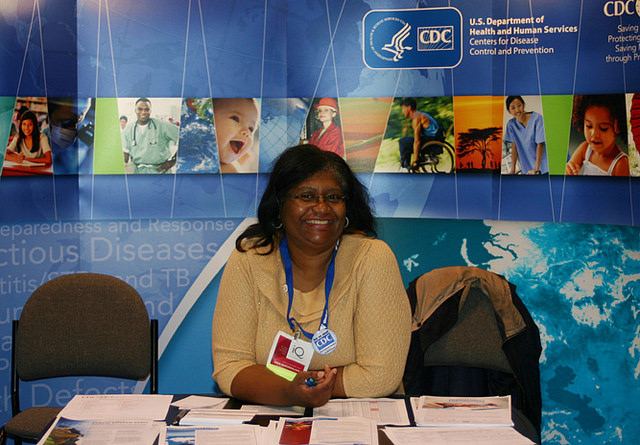


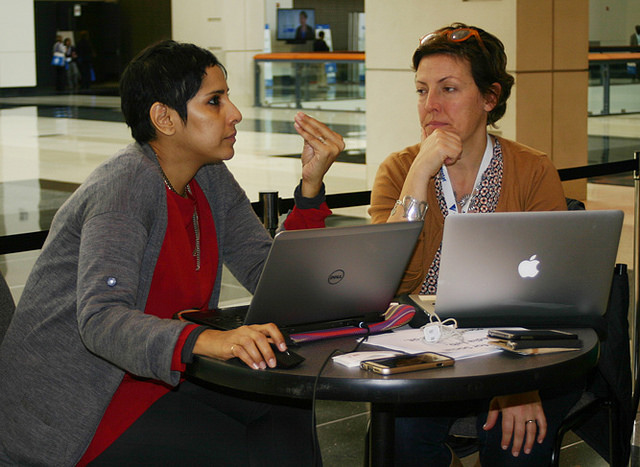
Let's take a moment to savor our time at this year's APHA Annual Meeting with some more photos from the last few days in Chicago. We can say good-bye in person at the Closing General Session, which starts in less than hour in McCormick Place Convention Center.
Above from top to bottom: Two attendees get excited about next year's Annual Meeting in Denver; all smiles at the Centers for Disease Control and Prevention booth at the Public Health Expo; getting to know each other at the Community Health Workers Section Business Meeting; hashing it out at the Caucus on Public Health and the Faith Community Business Meeting; and swapping tips at APHA's Social Media Lab.
All photos by Michele Late and Natalie McGill, courtesy The Nation's Health
Raising healthy babies one neighborhood at a time

When it comes to raising healthy babies, public health workers know that prenatal care is not enough.
And in communities where infant mortality rates are high, it takes more than health care workers to turn the tide. It takes collaboration.
That’s where programs such as Best Babies Zone, which was the topic of its own Wednesday morning session, come in. Started by the University of California-Berkeley with support from the W.K. Kellogg Foundation, Best Babies Zone involves building coalitions of businesses, early childhood centers, health care and more to improve the quality of life in small geographic areas with high rates infant mortality, low birth weight newborns and preterm births.
The program kicked off in the neighborhoods of Castlemont in Oakland, California; Hollygrove in New Orleans; and Price Hill in Cincinnati, Ohio. Those same communities are marked by low economic development and poverty. In Price Hill, the child poverty rate is nearly 56 percent, said presenter James Greenberg, director of the Cincinnati Children’s Hospital’s Division of Neonatology, who works with Best Babies Zone in Price Hill.
“If we’re going to address these complex problems like infant mortality, multi-sector approaches are absolutely essential,” Greenberg said. “Not only does that mean we have to think of community, health and political factors all at once; but as health care providers we have to think about why it makes sense to provide incredibly expensive neonatal intensive care without addressing drivers.”
An example of collaboration in action was Healthy Homes Block by Block, in which women in the Price Hill neighborhood serve as block captains and go door-to-door to offer information about infant safe sleep practices, safe housing remediation and children’s books. After one year, there were 50 child safety upgrades and 780 children’s books delivered across five blocks, Greenberg said.
Out west in California, more than a third of the kids younger than 18 who live in Castlemont live below the poverty line, said Jessica Luginbuhl of the Alameda County Public Health Department, who works with the Best Babies Zone’s Castlemont program.
Realizing that economic development is integral to health, community members involved with Best Babies Zone worked with residents and local businesses to create the Castlemont Community Market. The market highlighted local shops and promoted residents who were also entrepreneurs.
Today, 450 people have attended the market since January, resulting in $3,400 going back into the local economy, she said.
“The life course undergirds the work we do,” Luginbuhl said. “The bottom line is health is greater than health care. We feel that peoples' health are products of environments they live in and the opportunities they have. Those vary by where you live.”
— N.M.
A little birdie told me so: Tweet of the day
Today's Tweet of the Day goes out to @DrBMBrawner, who gave all of us a needed boost of energy on the last day of the Annual Meeting. We miss you too!
Had to come back home early and I already miss being at #APHA15 😔 GREAT conference this year!!! #Kudos to @APHAAnnualMtg organizers 🎉
— Bridgette M. Brawner (@DrBMBrawner) November 4, 2015
Chicagoans can ‘PrEP’ for sex without HIV
HIV infection rates in the U.S. have declined in the last decade but not in Chicago’s South Side, which has unfortunately experienced upticks of new infections in recent years.
But a new preventive drug is poised to make an enormous difference. And APHA members are on the ground making it happen right now, in spite of the barriers.
Pre-exposure prophylaxis, or PrEP, is a preventive strategy that lowers the risk of HIV infection by up to 92 percent among people who adhere to its guidelines, according to the Centers for Disease Control and Prevention. The strategy includes regular HIV screenings, medical monitoring, sexual health consulting and daily intake of Truvada, a drug approved by the U.S. Food and Drug Administration in 2012.
The bad news is that many obstacles stand in the way of people gaining access to PrEP. The good news is that Chicago’s public health workforce is demonstrably fixing the problem, as evidenced during a Wednesday morning session on “Keeping PrEP’s Promise: A Windy City Approach to a New HIV Prevention Paradigm.”
“We’ve enrolled over 200 patients to date,” said Sybil Hosek, PhD, of the John Stroger Hospital of Cook County in Chicago, which opened a PrEP clinic in April. “Our ultimate goal is to provide PrEP to whoever needs it whenever they need it.”
It’s not possible for the hospital to do this right now for a variety of reasons, such as electronic health system shortcomings, lack of staffing, physician availability and even insufficient hours of operation (the clinic closes at 4 p.m. each day). However, Hosek told session attendees that the hospital is aggressively creating solutions, with dedicated medical staff and doctors creating time and space to treat previously unmet patient needs.
Two other challenges have emerged in the early days of PrEP treatment: access and inequity. PrEP is covered by most insurance and Medicaid programs, but “it is very confusing,” according to Jim Pickett of the AIDS Foundation of Chicago, and many early PrEP patients are insured, employed and don’t mirror the typical demographics of patients who use public safety-net hospitals.
Pickett said that awareness and education among vulnerable communities — notably, young gay black men, transgender women and black cisgender heterosexual women — may be the foremost challenge. The foundation, along with the Chicago Department of Public Health and others, recently began a five-year plan to eliminate HIV in the city.
A citywide social marketing campaign is scheduled to launch in 2016, with a focus on “making sex positive,” according to Pickett.
“Love, lust, intimacy, pleasure — we’ll use these words because we want people to enjoy sex without fear, anxiety or shame,” Pickett said. “And … without HIV.”
To learn more about PrEP, check out this article from The Nation's Health.
— D.G.
But a new preventive drug is poised to make an enormous difference. And APHA members are on the ground making it happen right now, in spite of the barriers.
Pre-exposure prophylaxis, or PrEP, is a preventive strategy that lowers the risk of HIV infection by up to 92 percent among people who adhere to its guidelines, according to the Centers for Disease Control and Prevention. The strategy includes regular HIV screenings, medical monitoring, sexual health consulting and daily intake of Truvada, a drug approved by the U.S. Food and Drug Administration in 2012.
The bad news is that many obstacles stand in the way of people gaining access to PrEP. The good news is that Chicago’s public health workforce is demonstrably fixing the problem, as evidenced during a Wednesday morning session on “Keeping PrEP’s Promise: A Windy City Approach to a New HIV Prevention Paradigm.”
“We’ve enrolled over 200 patients to date,” said Sybil Hosek, PhD, of the John Stroger Hospital of Cook County in Chicago, which opened a PrEP clinic in April. “Our ultimate goal is to provide PrEP to whoever needs it whenever they need it.”
It’s not possible for the hospital to do this right now for a variety of reasons, such as electronic health system shortcomings, lack of staffing, physician availability and even insufficient hours of operation (the clinic closes at 4 p.m. each day). However, Hosek told session attendees that the hospital is aggressively creating solutions, with dedicated medical staff and doctors creating time and space to treat previously unmet patient needs.
Two other challenges have emerged in the early days of PrEP treatment: access and inequity. PrEP is covered by most insurance and Medicaid programs, but “it is very confusing,” according to Jim Pickett of the AIDS Foundation of Chicago, and many early PrEP patients are insured, employed and don’t mirror the typical demographics of patients who use public safety-net hospitals.
Pickett said that awareness and education among vulnerable communities — notably, young gay black men, transgender women and black cisgender heterosexual women — may be the foremost challenge. The foundation, along with the Chicago Department of Public Health and others, recently began a five-year plan to eliminate HIV in the city.
A citywide social marketing campaign is scheduled to launch in 2016, with a focus on “making sex positive,” according to Pickett.
“Love, lust, intimacy, pleasure — we’ll use these words because we want people to enjoy sex without fear, anxiety or shame,” Pickett said. “And … without HIV.”
To learn more about PrEP, check out this article from The Nation's Health.
— D.G.
Start spreading the news!
With so much exciting new science coming out of the 143rd APHA Annual Meeting and Exposition, it's no wonder we're making headlines. From the mental health effects of binge watching TV to food insecurity among college students, the public health research being presented in Chicago is showing up in media outlets across the country. Below is a quick, but not comprehensive, round-up of all the attention we're getting.
Modern Healthcare: Public health issues push past flu and cigarettes into socio-economic areas
CNN: Kids seeing more unhealthy snack ads, report says
Chicago Tribune: Health conference calls for access to abortion as 'human right'
New York Daily News: Binge-watching may lead to depression and other health problems
ABC Radio: Study: Letting your teen party at home could lead to addiction
MedicalResearch.com: Many college students struggle with food insecurity
International Business Times: Why are anti-vaxxers so persuasive? Pseudoscience, misinformation and healthy behavior
Medical Daily: Lazy Boy: People who don't exercise twice as likely to develop alcohol abuse problems
Business Standard: How Ebola scare stigmatized African immigrants in U.S.
Modern Healthcare: Public health issues push past flu and cigarettes into socio-economic areas
CNN: Kids seeing more unhealthy snack ads, report says
Chicago Tribune: Health conference calls for access to abortion as 'human right'
New York Daily News: Binge-watching may lead to depression and other health problems
ABC Radio: Study: Letting your teen party at home could lead to addiction
MedicalResearch.com: Many college students struggle with food insecurity
International Business Times: Why are anti-vaxxers so persuasive? Pseudoscience, misinformation and healthy behavior
Medical Daily: Lazy Boy: People who don't exercise twice as likely to develop alcohol abuse problems
Business Standard: How Ebola scare stigmatized African immigrants in U.S.
Subscribe to:
Posts (Atom)